

Chirotherium trackmaker
digital drawing, 2026
life-size model with back sail
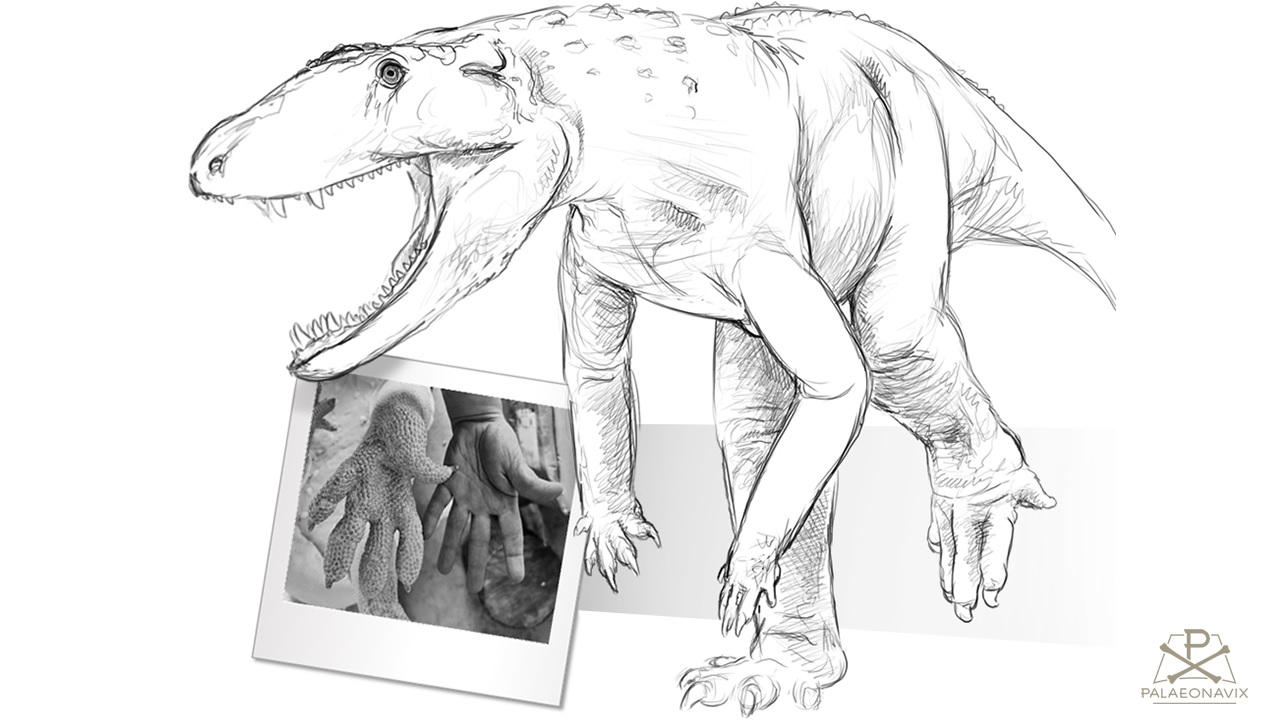
In case anyone should ask how Chirotherium got its name: The Greek combination for the Hand Beast was coined in 1834 for strange fossil tracks that resemble human hands. It is one of the most often told stories regarding the history of palaeontology: the long search for a convincing trackmaker, no longer assuming a large mammal or amphibian. In fact, Chirotherium was produced by larger Triassic pseudosuchians, a highly diverse group of archosaurian reptiles back then.
Therefore, it nests among the stem group of all modern crocodiles, a clade in which the outermost toe of the foot is greatly reduced. On the evolutionary path towards this condition, chirotheres spread this fifth toe sideways and slightly backwards, in order to stabilise the narrow erect gait. So, what reminds us of a human thumb actually corresponds to the same position as our little toe.