

Anatomy of a seed fern
digital painting, 2021; artwork by Freddi Spindler
more about Permian plants / an animal climbing the Chemnitz Petrified Forest
Museum of Natural History Chemnitz
Palaeobotany has two major problems. One is unfair and unjustified: this discipline is somewhat marginalised within our field. At conferences, it is given a minor token session, often in remote, small rooms. This is, of course, because there are far fewer palaeobotanists, working in very few positions, in very few specialised museums or institutes. In Germany, the research centres can be counted on one hand, and you don't even have to be pentadactyl for that. Yet the discoveries are sensational, the methods absolutely fascinating, and the importance of botany far greater than that of some saurian research. Not that we want less dinosaur research – five times as much palaeobotany would be a good start. There's plenty of work to do.
The second problem results from the nature of the object of investigation and thus constitutes something like a detective challenge. This is the matter of parataxonomy, because wood, leaves, fruits, pollen and seeds are generally found strictly separated in the fossil record. Plants have a different physical integrity and consequently undergo different decay processes than animals. Only a few sites preserve entire organ associations, namely when embedding took place quickly and without prior transport. These are not the best habitat conditions for plants, but where would that ever be the case? The most important site worldwide with this potential is the Petrified Forest of Chemnitz. In the early Permian period, a densely populated forest area was devastated by the pyroclastic surge of a nearby volcano. Some plants were bent over and – after laborious preparation lasting years – allow for the correlation of fronds, woods and fruits.
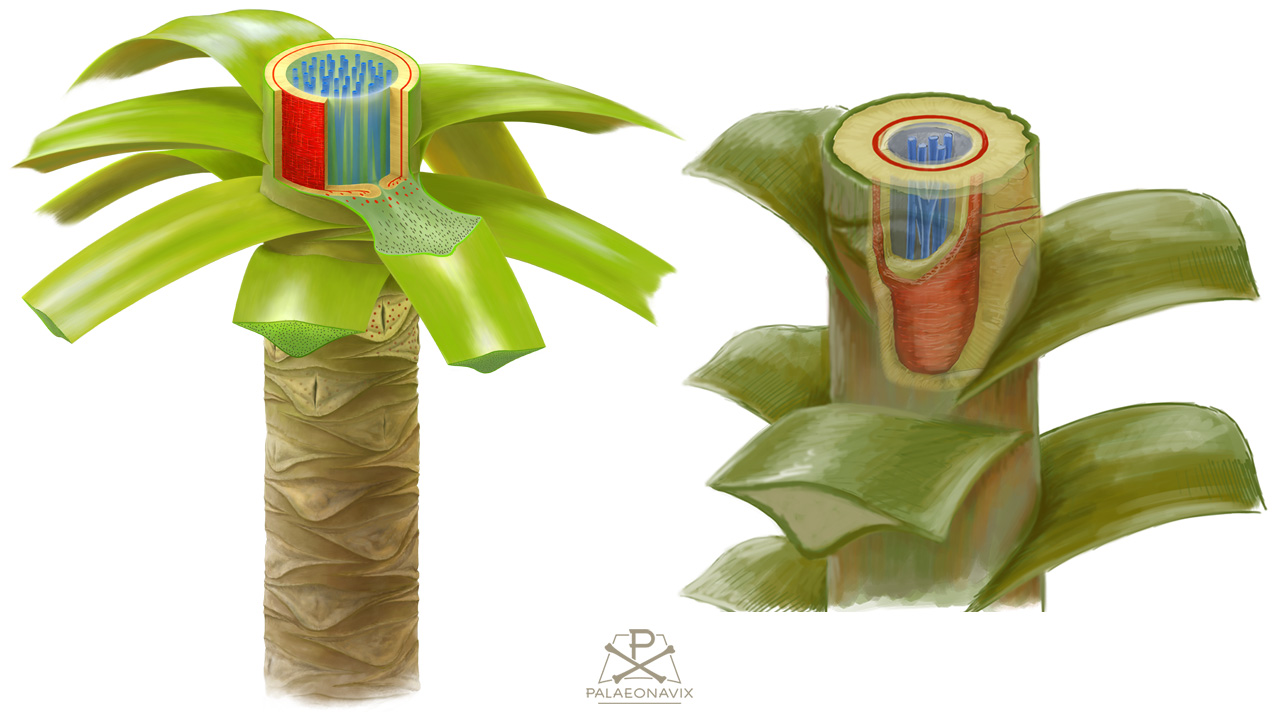
This rather schematic illustration refers to a seed fern named Medullosa stellata var. typica Cotta, 1832. Seed ferns are now extinct representatives of more primitive seed plants. They were very important in the Carboniferous and Permian periods, by the Mesozoic era they declined, and in the early Cenozoic only a few survivors remained. As the name seed fern correctly suggests, they grew real seeds, meaning they had evolved away from the stage of spore plants (non-seed-bearing plants). They retained the frond-like appearance of ferns, as their name incorrectly suggests. Let's just say that the common ancestor of ferns and seed plants probably passed on this leaf shape to both. You really have to be a botanist to recognise from a single fossil frond which major group a fern-like leaf belongs to.
Because the preservation in the Chemnitz Petrified Forest allows such good conclusions to be drawn – in situ and three-dimensionally – this task focused on the anatomy of the trunk and the frond bases. The metre-long fronds were apparently arranged in a spiral pattern, which can be seen in the fossil. Microscopic examinations reveal how the conducting vessels are interconnected. The primary xylem, the water-conducting system in vertical and transverse directions, is marked in red. A kind of tube of the primary xylem exists in the middle of the plant, in medullosalean plants amidst the secondary xylem, here yellowish. This wooden body, which allowed the plant to grow to a height of several metres, thus grew outwards and inwards. The outer wood ring was punctured in places by the primary xylem, namely where a leaf scar realised the branching into the frond.
The version on the left is, of course, the correct one, which was also used in the publication. I consider it to be a bit too strict and overly saturated. As a semi-schematic illustration, this is quite appropriate. However, since there was an intensive process involving sketches, geometric constructions, and discussion, and because preliminary results also have their own charm, a step in the development can be seen on the right. The proportions are not correct because the sketch was not yet based on the comprehensive data. It is more of an experiment on how virtual cutting effects or transparencies can be used. The botanists who ordered the illustration have the final say, of course. It's just a little reflection about the long road to a finished illustration, for further thinking.
Luthardt, L., Merbitz, M., Fridland, E., & Rößler, R. (2022): Upside-down in volcanic ash: crown reconstruction of the early Permian seed fern Medullosa stellata with attached foliated fronds. PeerJ, 10: e13051. https://doi.org/10.7717/peerj.13051