

Ammonites‘ demise
digital painting, 2023
for Ammonite Masterpieces / explore some geologically older ammonoids
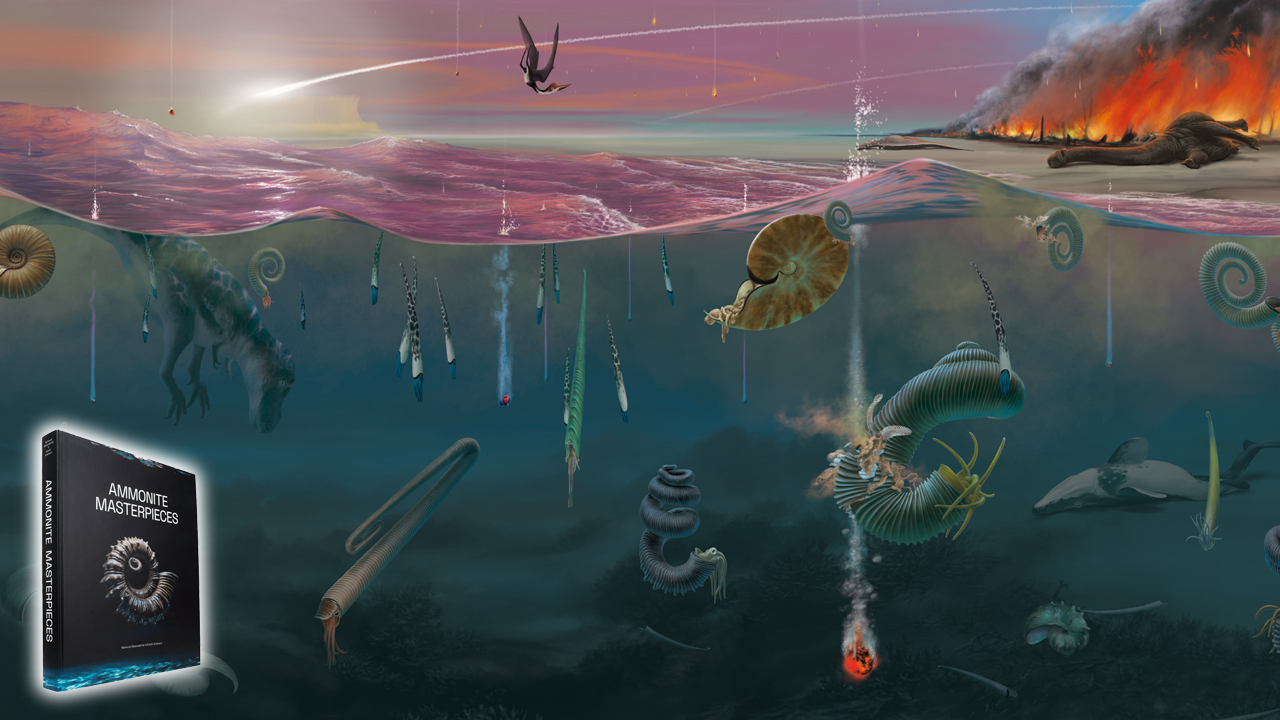
Everyone is familiar with it: end of the Cretaceous period, great mass extinction, dinosaurs gone, really bad. And that the meteorite was to blame. Everything else goes beyond common knowledge: that birds were not the surviving dinosaurs across the board, but that many bird groups also died out completely; that the pterosaurs were gone, and the plesiosaurs and mosasaurs of the oceans. Perhaps the most significant extinction among invertebrates occurred for the ammonites, as they were a fixed component of marine ecosystems long before most aquatic reptiles.
Ammonites are not squid. They are recognisably related to them, admittedly. They are also not nautilus, even if the curled shell with floating body might tempt you to think so. Ammonites are just ammonites, with their own type of shell, most probably ten arms - and contrary to many depictions, without suction cups on them! The strictly mathematically curled shape gave way to some elongated or sometimes even crazier shapes, especially in the Cretaceous period. So even if some of the ammonites in this picture are visibly suffering: The shape of their shells has always grown quite healthily. Until this very day...
Most of you have already guessed that this is a rather symbolic image, anachronistic or diachronic. It shows deliberately eye-catching elements of the extinction event. You certainly wouldn't have really come across this compilation. I don't even mean that the meteorite has only just hit the ground, while the fire is already raging on land and the sea is being devastated by the bombardment of the debris. Up to this point, it's just a comic without frames. The crucial point is that many people associate mass extinction with mass mortality. That is just incorrect. The time span of this non-comic must therefore be defined more broadly.
Extinction, or mass extinction (if many species are affected by the same scenario), refers to the decline in populations so that the mortality rate exceeds the reproduction rate. We would not have experienced many mass extinctions (in our imaginary time machine) as fields of corpses. The ammonites, of all things, survived the end of the Cretaceous a little longer. The last species didn't hang around as individuals for hundreds of thousands of years, but their populations declined. This is a significant difference to mass death, which is possible, for example, during anoxia in a lake or after volcanic fallout.
The mass extinction at the end of the Cretaceous period (66 million years ago, not 65) is neither the only major nor the most severe of all time, nor were extinction events always this devastating. This particular event is famous, firstly because of our tragic loss of large dinosaurs. Secondly, because short-term catastrophes do play a role here. The end of the Cretaceous can also be explained by volcanic phenomena, including the global iridium anomaly. So it is not solely impact-based, just because the North American perspective has internalised this as part of its pop culture.
Nevertheless, this cannot minimise the huge impact in the Gulf of (attention!) Mexico. The sediments from the Atlantic seabed clearly show that the microorganisms above a layer of ejecta debris, which is atypical for the seabed, are ecologically stressed: they are rarer, smaller and much less diverse. There is no question that the impact was one of the coffin nails for dinosaurs and ammonites. (By the way, I owe a lot of information to a worthwhile lecture by Dr. Christina Ifrim, who is just as eager to find out whether samples can be recovered from the centre of the crater, in order to prove they date still within the Cretaceous).
But why were the ammonites finished off in this way, either immediately or later? Their reproductive strategy was actually suitable for surviving adverse situations. They were predominantly small or medium-sized and could obviously eat anything that fitted into their small mouths. And their reproduction was quantity over quality: a single female laid hundreds, if not thousands, of tiny eggs during each cycle. This is the conclusion drawn from repeatedly found microscopic ammonite larvae.
Possibly their weak point was that they left the eggs floating on the water surface as a clutch of eggs. There is also indication of this strategy. If this is true, vast numbers of embryos would have been exposed to all the unfavourable influences of the long-term catastrophe over extended intervals. Climate fluctuations, ocean chemistry, atmospheric toxins, dust, spoilt plankton food or disturbed shell formation - there are many possibilities. The ammonites would probably have survived the meteorite impact as just another crisis. But together with the super volcanoes, it turned into a deadly drama that lasted for thousands of years, but started on a really bad day that spring.