

Archaeorhynchus, flying chicks from the Cretaceous
digital drawing/painting, 2019; all artwork by Freddi Spindler
In evolutionary history, uncertainties are actually something to be welcomed. What could be better than blurred boundaries? Because that means we see more of the true history. For example, if we ask when birds first appeared, and you remember Archaeopteryx, that famous primeval bird from Bavaria with a long tail column, clawed fingers and teeth, then you say: the first birds appeared in the Jurassic. And on the one hand, this answer is completely correct, namely if you are referring (perhaps unconsciously) to the group of Avialae, which are birds in the broadest sense, and as you correctly noted, from the Jurassic period onwards. Even a little before Archaeopteryx, because according to your statement, it is already a bird, and it had to come into existence at some point.
In short, in some ways you are right. But in other ways you are also completely wrong, because precisely because all bauplans require time to develop gradually – whether quickly or slowly, but almost always gradually – you could never say exactly where the boundary lies when observing evolution. On which day did a particular ancestor of the Avialae birds make the leap or glide that used a little more of its own propulsion? In which year did a particular member of the pack develop the one missing skeletal feature that visibly and significantly changed the quality of its entire offspring? In other words, even if you look at a period of only a hundred thousand years and know absolutely everything about it, you can only attest to a slight change in a species. It may be visible, perhaps even a key adaptation. But the species in your study has (or have) not changed its entire nature.
Now, we cannot claim to have a continuous observation based on the fossil record, but only a series of tiny insights. And yet, the origin of birds is now so well known that we see blurred boundaries. Where exactly should we say: This is a bird, the other one is not yet? Each individual characteristic could appear multiple times and then disappear again. Even if it doesn't, another expert may consider another character worthy of defining it. The familiar characteristics of birds did not emerge all at once. This is unsolvable, and that is good news: the more difficult it is for us to draw the boundaries, the more representative the fossil record is. Fortunately, this has been the case with birds in the last few decades, and we have witnessed it! With pterosaurs, for example, we are still waiting, as it is still possible to draw a clear line.
With birds, however, the crown group model applies. Not that it addresses the actual evolutionary transitions by drawing clear boundaries. But it sorts groups without raising a single character change as a new era for a group, just so that experts can get bogged down in debate about it. The crown group of birds simply means: The last common ancestor of all birds still living today and all its descendants, whether they are extinct lines within this lineage or still exist today, are all undoubtedly birds. So the common ancestor of ostriches and sparrows, or kiwis and parrots, is probably bird enough that we can assume fossil representatives within this spectrum: Yes, Diatryma belongs to it, too, or the terror birds, or whatever. Purely formal, but quite helpful as a classification principle. And it only takes us as far as the late Cretaceous period, which is only halfway between Archaeopteryx and the present.
It is thus clear that the ancestors of this last common ancestor also corresponded to the nature of birds in terms of their external and internal characteristics. However, we do not expect them to fall within the spectrum known today. After all, the definition of birds was first written down at a time when very little was known about fossils, let alone evolution. Strictly speaking, everything between Archaeopteryx and the (unknown) last common ancestor of modern birds is not undoubtedly a bird. According to extant biology, which has, so to speak, authority over group names, we can only say with certainty that the closest living relatives of birds are different and how they are different. In this case, that would be crocodiles. This means that everything that is closer to birds than to crocodiles is under general suspicion of having developed bird characteristics at some point.
And this is consistent with the fossil record, because these so-called stem birds include pterosaurs and various lineages we call dinosaurs, which show clear tendencies towards birds in their respiration, feather development, brain structure and so on. Brontosaurus and Triceratops are also stem birds, which sounds crazy and does not declare them to be actual birds. However, they make it clear that we should certainly not derive their nature primarily from the observation of crocodiles or even lizards. They have become something entirely unique, and this uniqueness is partially still preserved in today's (crown) birds.
Let us ask again, since when have birds existed? Jurassic is as correct as it is incorrect. On average, this is not accurate enough for us. The broadest definition – Avialae from the late Middle Jurassic onwards – is artificial and has developed historically (if Archaeopteryx had been discovered later or had not served as the sole primary source for most of research history, the story would be quite different). The intermediate definition is vague, if not subjective – birds, by their very nature, cannot be confined to sharp boundaries in what are actually gradual transitions. Dentition, tail length, finger claws – all of these are subject to certain on-off phases in the phylogenetic tree of Cretaceous birds. All that remains is the narrow and strict definition of the crown group, the safe bet, so to speak: birds as modern birds, called Neornithes, have existed since the late Cretaceous period.
In the history of research, this approach would also have remained consistent with the appearance of known fossil birds for a long time. We knew of toothed birds that looked very modern in terms of their skeleton, but had teeth. These were clear intermediate stages and, in today's terminology, stem birds. We also knew of enantiornithines, but initially very little, and with increasingly better finds, their skeletons and dentition were primitive enough to convey essential differences.
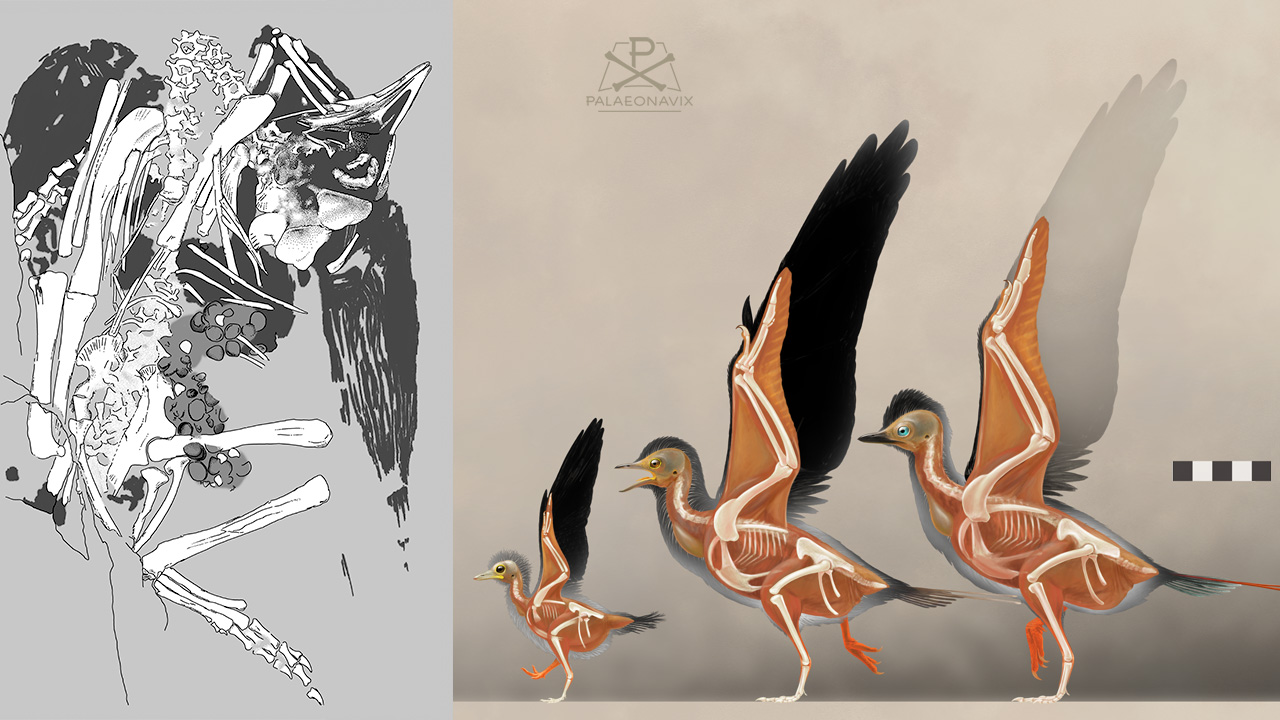
But what about creatures like these (I should finally say something about the image) – this is Archaeorhynchus. Not Archaeopteryx = ancient wing, but Archaeorhynchus = ancient beak. The name says it all, because Archaeorhynchus had a toothless beak at all stages of its development. In terms of phylogenetic history, this genus is still in its early stages within the short-tailed birds (Pygostylia, more precisely the Ornithothoraces), i.e. it belongs to the base of Euornithes, just a little closer to modern birds than to the Enantiornithes. It would be wrong to think that this means everything is clearly sorted out. Euornithes can also have teeth, except for the Neornithes subgroup, which is still alive today. Conversely, Enantiornithes can have toothless beaks. The fact that Archaeorhynchus has a strong claw on its front finger is not so unusual, because even though there are few of them, very different modern birds have the same claw.
What is perhaps even stranger is that the tail feathers seem to be more decorative than functional (yes, this is known from soft tissue preservation). However, many Cretaceous birds were quite experimental in this regard. Simple stubby tails are common in Enantiornithes, but I have seen a Little Grebe flying (if you can call it that), and there is not much going on with the tail feathers there either. The truth about why Archaeorhynchus is at the base of the Euornithes lies in many small skeletal features that meet with even more small skeletal details of other birds in a matrix and tell the computer: My sternum is a bit like that, but not completely, and my pelvis is more modern in five features, but still rather primitive in three, and so on. This makes it clear once again that drawing boundaries is bound to fail, even when we get so close to the last common ancestor of modern Neornithes.
However, Archaeorhynchus does contribute something to the question of what creatures the Cretaceous birds actually were. As mentioned above, this has nothing to do with their classification as crown or stem birds. We would always refer to Archaeorhynchus as a bird if it were a living animal, what else could it be? But stem birds are allowed to break ranks in a way that representatives of crown groups cannot. Archaeorhynchus is doing just that with its growth strategy. We were lucky to examine a young bird a few years ago. Identifying, describing and naming new species is flattering to the researcher's heart, but would be a bit tricky with very young babies anyway. In this case, the great thing is that the chick can be determined. It is also a fortunate coincidence that both the half-grown and adult specimens of Archaeorhynchus and ‘our’ juvenile have retained at least enough plumage to allow the minimum length of the primary wing feathers to be measured. The skeleton of the juvenile is still very immature, yet the primaries are proportionally as long as those of the adult birds. This is indeed unusual.
Such a paradox also exists in today's birds, namely the chicks of the Australian malleefowl, which cannot expect any parental care after hatching, but fly short distances from day two onwards, with well-developed wings and no pronounced tail feathers. Within the Neornithes, this appears to be a remarkable anomaly. There is some indication that this was the norm among the ancestral birds of the Cretaceous period. Other young birds also seem to develop flight feathers very early, but the only known cases are Enantiornithes. With Archaeorhynchus on a different lineage, the hypothesis becomes possible that birds – and again the question arises: which ones? – generally come from an evolutionary stage with extremely early onset of flight. Considering that pterosaurs also hatched from eggs with the ability to fly, we could come to the conclusion that in the Mesozoic era, one would first have to prove the opposite for flying vertebrates, namely that they were nestlings and developed the ability to fly at a later stage. From this perspective, Archaeorhynchus may appear to be a bird on the outside, but its nature is not like that of birds as we know them.
Foth, C., Wang, S., Spindler, F., Lin, Y., & Yang, R. (2021): A Juvenile Specimen of Archaeorhynchus Sheds New Light on the Ontogeny of Basal Euornithines. Frontiers in Earth Science, 9: Article 604520. https://doi.org/10.3389/feart.2021.604520