Permian megafauna
digital painting 2024
Urweltmuseum GEOSKOP Burg Lichtenberg (Pfalz)
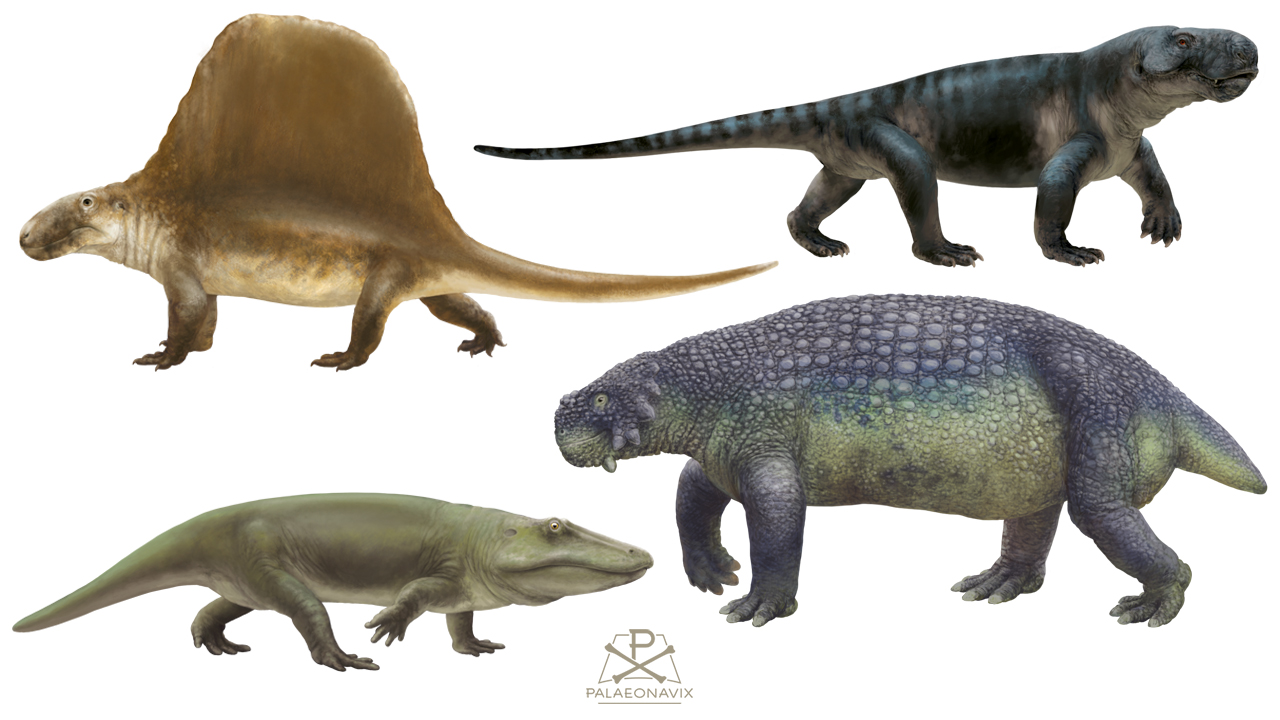
It's easy to understand why many people feel that every ancient four-legged friend is part of an undefined mass of primitive and freaky creatures. The relationship to today's representatives is generally something that requires explanation. Nor do they have the free ride of the dinosaurs due to a lack of gigantism and coolness. Trivial names almost never exist, even for entire families and evolutionary lines. In German, the term “Ursaurier” (“proto-saurian”) has become established: Some tetrapod from the pre-dino era.
All four of the species shown here are from the Permian. The two on the left represent the early Permian, actually already the end of the Carboniferous. At the top left is perhaps the best-known tetrapod of the entire Palaeozoic: Dimetrodon. Such animals, the so-called pelycosaurs, also existed without the tall back sail with a bone bar from each vertebra. They still look like chubby lizards without necks, but make it more plausible that later mammals evolved from such forms. Dimetrodon was approximately between 1.5 and 3.5 meters long, making it a top predator in most of its ecosystems. The broad discussion about the meaning and function of the dorsal sail deserves a better place elsewhere than in this caption.
Let's continue at the top right. Because these therapsids – formerly summarized as “mammal-like reptiles” – are exactly the next evolutionary stage following the pelycosaurs. They are significantly more upright in their gait and have more differentiated dentitions, both clear advances on the way to mammals. Nevertheless, without knowledge of their relationship, we would have erroneously classified them as reptiles, as they still lack fur and external ears. On display is Archaeosyodon, a carnivorous dinocephalian (translated as “ fearsome heads”) from the Middle Permian. At this time there was not much left of the pelycosaurs. The therapsids had achieved global dominance among large land animals.
This does not mean that reptiles were doing badly in evolutionary terms. They evolved many species, and in the Middle Permian even the first split of modern reptiles, so that the direction of lizards and, on the other hand, that of crocodiles and dinosaurs had already been taken. However, the vast majority of reptiles were smaller than the majority of therapsids. An important exception were the pareiasaurs of the late Permian. Below right there is one of the largest representatives: Scutosaurus, 3 meters long and weighing over a ton. They were the largest herbivores of their time. The fact that they originated from a more primitive lineage and do not fall within the spectrum of modern reptiles demonstrates the enormous diversity of these old tetrapods.
Below left we are back in the early Permian with Eryops, an amphibian from the broad group of Temnospondyli. When fully grown, such animals might be confused with alligators, and their ecological role was certainly similar. The big difference to reptiles and mammalian ancestors at this time was that amphibians produced very small eggs and aquatic young. This makes the growth performance all the more astonishing, as Eryops grew from a larva in the range of millimetres to over 2 meters. Their numbers must have been correspondingly high to guarantee their chances of survival among many hungy invertebrates, fish, amphibians and pelycosaurs. Not least in this respect, large amphibians were somehow fishes with legs.