
Clams / Bivalves
digital painting 2024/2025
academic education, Tech.Univ. Bergakademie Freiberg
see an extant representative / compare with brachiopods
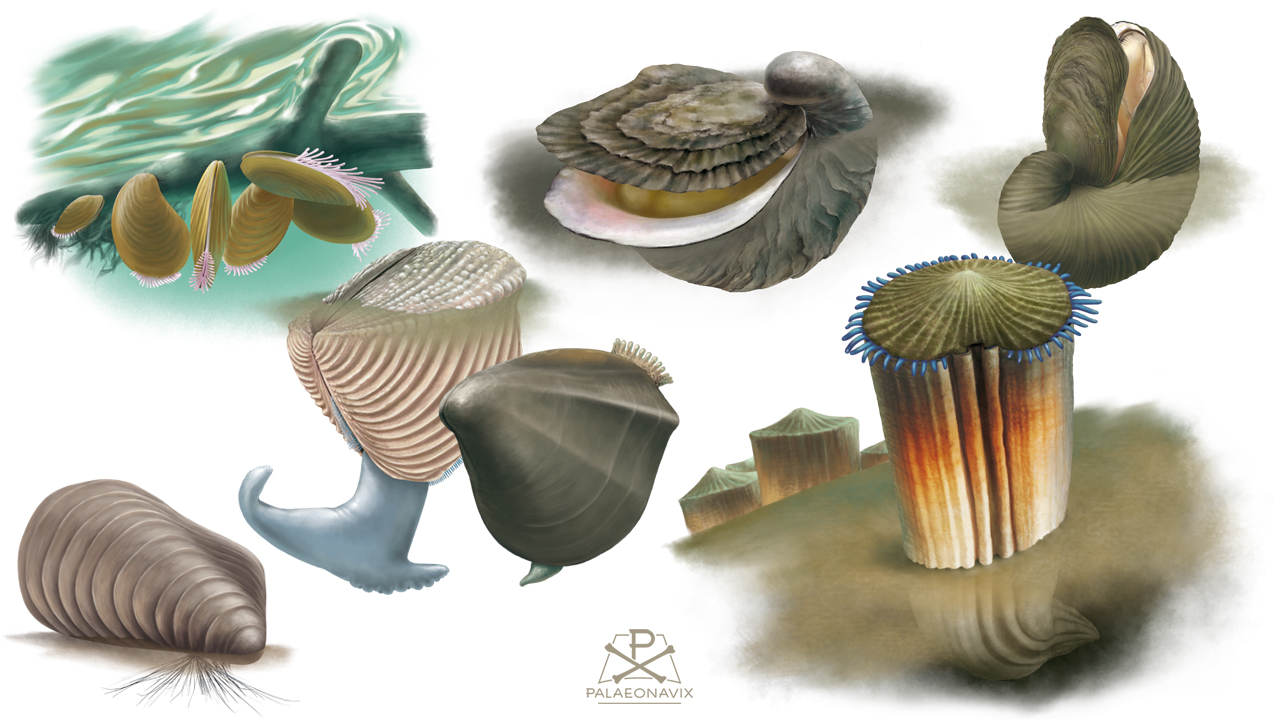
The disparity of bivalves is remarkable, most extreme in worm-like forms with relatively small shells. This basic bauplan is characteristic of all subgroups, but varies considerably. Unlike brachiopods, which have upper and lower shells, mussels have a right and left valve. However, this symmetry is often not maintained, but tilted into a functional upper and lower shell.
On the left-hand side, symmetrical forms can be seen, i.e. the shell parts are mirror-inverted except for their hinge area. At the top are specimens of Bositra (formerly assigned to Posidonia) from the Early Jurassic period, which were able to attach to flotsam with byssus threads and filter in near-surface waters.
Two trigoniids, Trigonia and Myophoria, can be seen in the centre of the image. The heavily sculptured Trigonia resembles the only extant genus Neotrigonia and was able to burrow by pulling its body into the seabed with powerful movements of its muscular foot. The asymmetrical profile of the thick shell ribs acts as a barrier, allowing movement in only one direction to prevent it from sliding back during the next pulsation of the foot. In Myophoria from the Triassic, the foot is shown retracted, while the funnel for water exchange is shown extended.
Inoceramus on the bottom left could grow to enormous sizes, ranging from decimetres to metres! It can be assumed that some of the many Cretaceous species were half buried in the sea floor. Others, as shown here, probably stood mostly exposed in the water. They were able to anchor themselves in soft, loose-grained substrates with hardening byssus threads.
On the right-hand side are bivalves that have effectively reversed the right-left symmetry into an up and down. In today's oysters, this is achieved simply by growing with the left shell on the hard substrate, so that one side is shaped down to the smallest detail even without genetic control. Some oysters lived in soft substrates and can be reconstructed differently. At the top and centre of the image are the gryphaeid oysters Gryphaea (Jurassic & Cretaceous) and Pycnodonte (Cretaceous to Pleistocene), one with a wide lip interpreted as a lying aperture, the other with a steep opening.
Finally, at the bottom right, there are a few rudists, those now completely extinct bivalves that require quite a bit of imagination to believe their classification. There were even rudists that formed colonies in long tubes, forming gigantic reefs (at university, they were referred to as ‘spaghetti reefs,’ but I couldn't find this term online). The best known are these solitary rudists Hippurites. The right shell was excessively enlarged and raised like a cup, while the left shell acted as a lid and was connected to the sculpted side of the lower part by the hinge.
Thus, despite all the variation in clams and its kin, a basic structure remained recognisable. Most species of this very important group also share a relatively to completely sessile lifestyle as filter feeders.