

Temnodontosaurus
digital model, used for miniature 3D prints
Museum Kloster Banz / Urwelt-Museum Oberfranken, Bayreuth
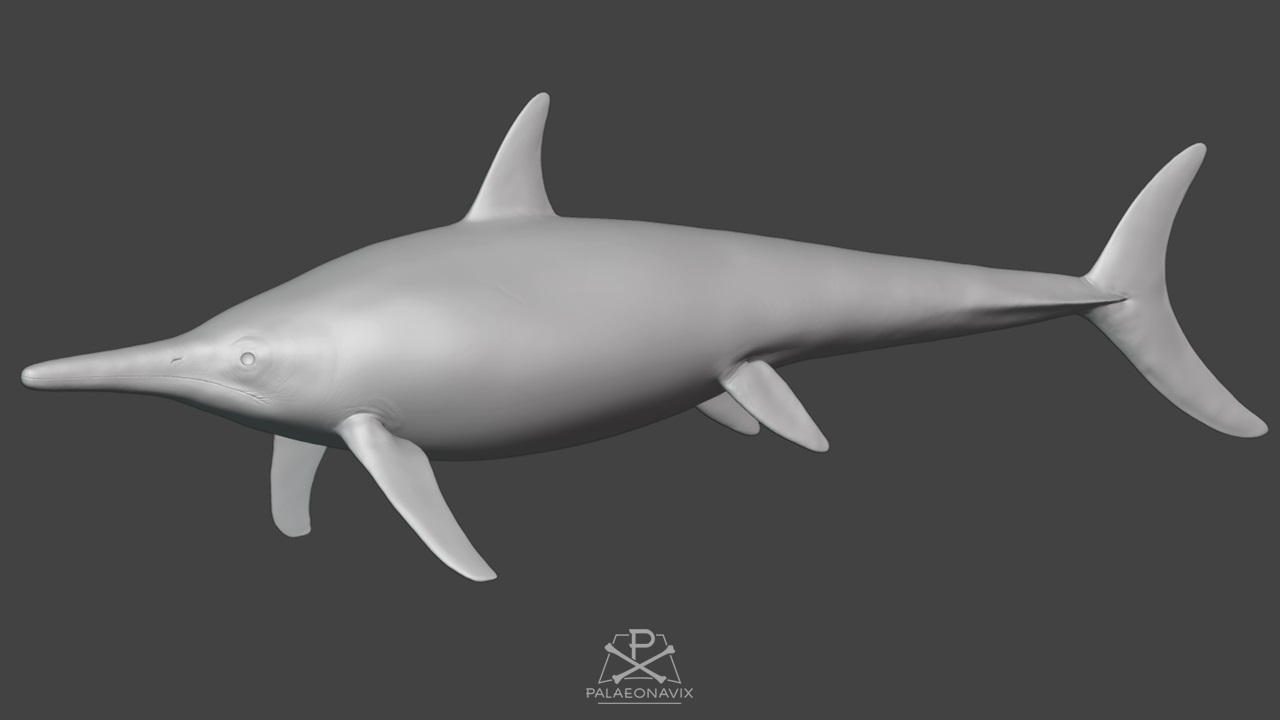
Most ichthyosaurs measured a few metres in length. Some very early representatives grew super-large, up to the size class of the bigger baleen whales of today. From the Early Jurassic on, their maximum seems to decline, which is no surprise given the evolutionary success of sauropterygian marine reptiles. So, for the late Mesozoic, this Temnodontosaurus was among the biggest ichthyosaurs. Skull lengths of about 2 m suggest a total length exceeding that of the extant orca. Since we prefer to check with own reconstructions, this model refers to a 9 m stage of adult Temnodontosaurus, and there are finds that suggest significantly bigger individuals. Fossils can be visited, for example, in Banz and Bayreuth, two Franconian collections that date back to the pioneering days of palaeontology, somehow paralleling the great work of Mary Anning in Dorset (on a largely similar Early Jurassic fauna).
Just when the first 0.6 m miniatures were printed, a study was published with the complete soft tissue outline of the front flipper. The image shows the corrected proportions, with the soft continuation far beyond the distal-most bones of what is homologous to our fingers. This proven enlargement gives the entire animal an even stronger whale-like appearance. What’s missing in the applied scale: The rear edge of each flipper wore a jagged contour, resembling the modified plumage in penguins. The adaptive value of those structures is interpreted as for noise suppression. Some scary Jurassic monster dolphin…