

Cartilaginous fish, stem and crown Chondrichtyes
digital painting 2024, 2025
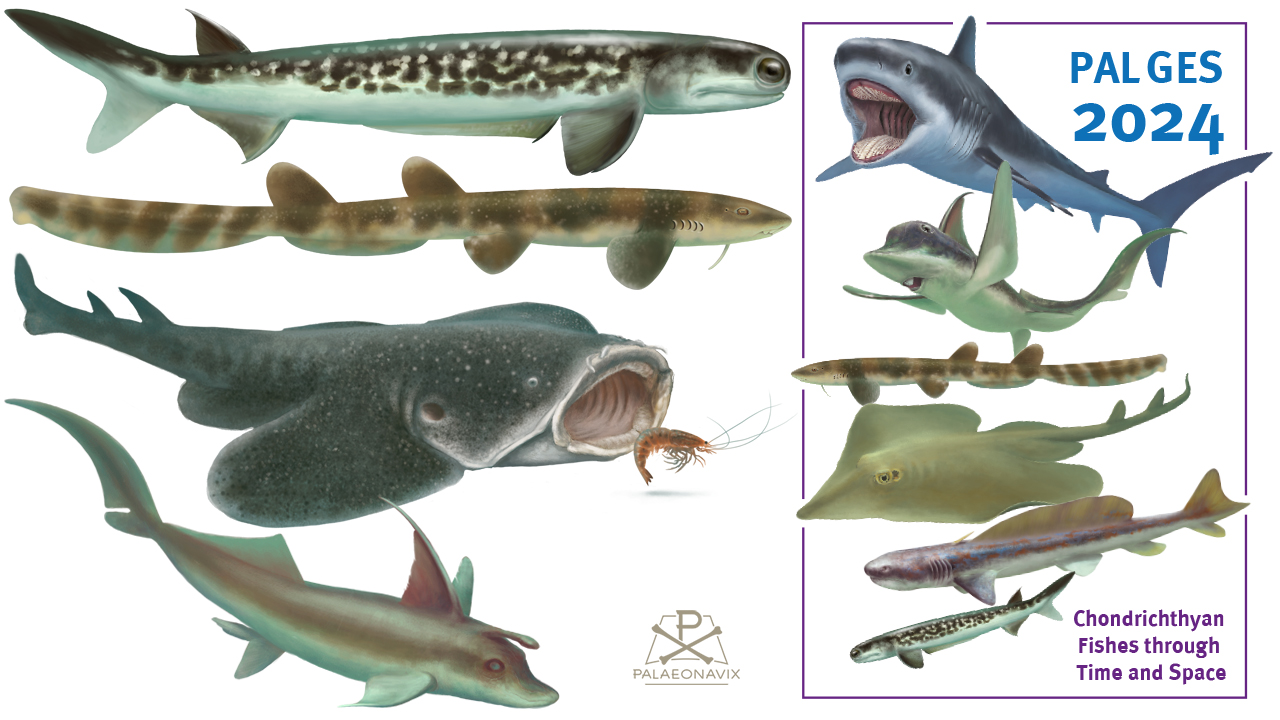
Some chosen cartilaginous fishes, left side: Acanthodes (‘spiny shark’, Acanthodiformes, Early Permian); Bavariscyllium (‘catshark’, Carcharhiniformes, Late Jurassic); Pseudorhina (‘angelshark’, Squatiniformes, Late Jurassic); male Ischyodus (‘ghost shark’, Chimaeriformes, Later Jurassic).
On the right combined as a panoply or some kind of opening title for a conference session: Ptychodus (durophagous mackerel shark, Lamniformes, Late Cretaceous); a female Ischyodus and Bavariscyllium again (see above); Apolithabatis (stem ray, Apolithabatiformes, Late Jurassic); Orthacanthus (stem elasmobranch, Xenacanthiformes, Early Permian); repeated Acanthodes (see above).
Among the vertebrates that have jaws – and let's be honest, there is something normal about being on the move with jaws – cartilaginous fishes represent the most primitive branch still alive today. Accordingly, their origins date back a long time, to the early Silurian. They are phylogenetically opposed to the bony fish, meaning not only the fish-bonefish, but also including the tetrapods, as some kind of special case of the coelacanth-and-lungfish lineage.
The 'spiny sharks', Acanthodii, have long been controversial because they have strange skulls, strange fin spines and strange bone-like scales. In the meantime, they have been recognized as stem group representatives of the cartilaginous fish, which sheds more light on the ancestral conditions of the jawed animals.
The next higher branch within the cartilaginous fishes are the Holocephali, represented today only by chimaeras (ghost sharks or rat fish), since the early Carboniferous. Everything else could be roughly summarized as sharks in a wider sense, Elasmobranchii (meaning platy gills). This is misleading for non-experts, albeit simplistic, because very primitive forms such as the Xenacanthiformes of the Carboniferous and Permian can also be considered sharks. Strictly speaking, only the modern Neoselachii can be classified as either sharks, Selachii, or rays, Batoidea. These lineages have been present since the Jurassic, and the Late Jurassic examples do not look fundamentally different from today's cartilaginous fish.