

Fungus-infected Lichen
digital painting, 2022
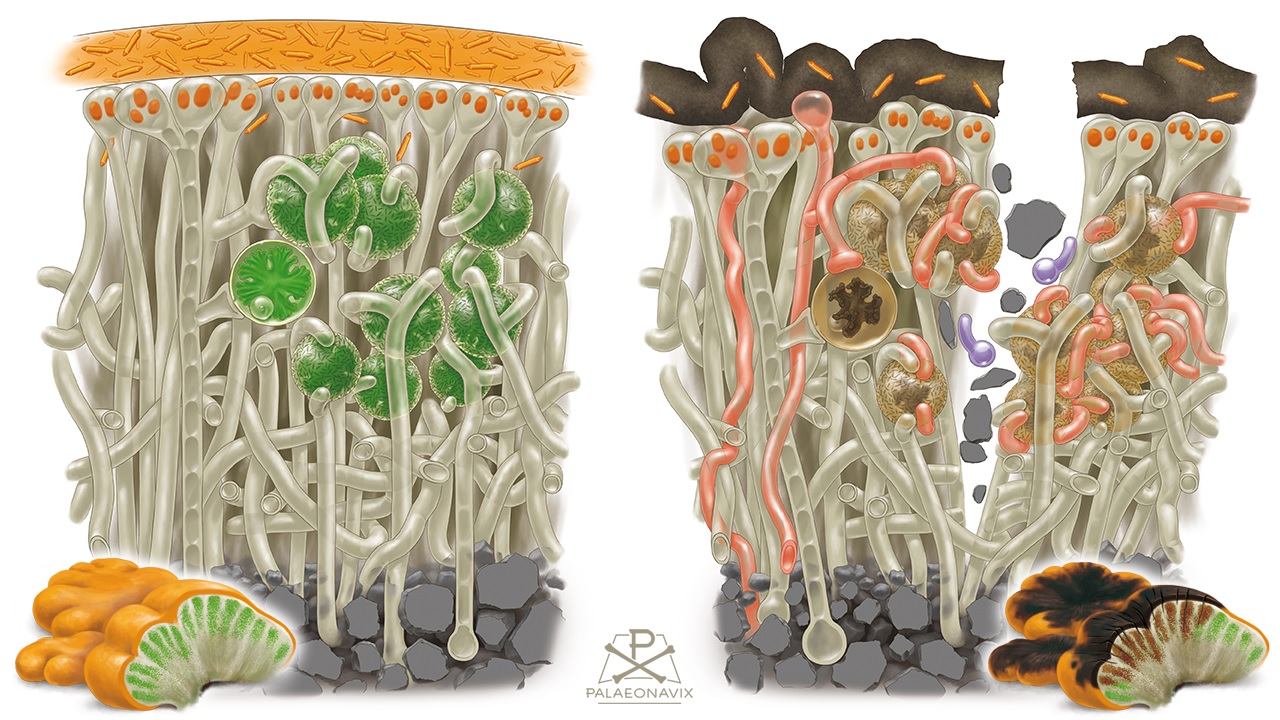
Lichens are fungi in the first place, just presenting the lichenized form, which may or may not be paralleled by an un-lichenised form of the very same species, and sometimes of a rather dissimilar appearance. The symbionts are cyanobacteria or eukaryan algae.
In the case illustrated here, the story gets a bit more complicated. A team of biologists found a strange condition of the lichen called “Caloplaca santessoniana” in the Atacama. The normal photobiont is a Trebouxia green alga. Where desiccation causes too severe cracks, mineral debris can fill the gaps, which would not threaten the lichen. But if the dust contains spores (violet) of the lichenicolous fungus Didymocyrtis (pink), the photobionts die off. These now brown regions are no longer an intact lichen, but a fungus-infected fungus. The surface increase is a feedback for further spores to flourish.
For full labelling and background see Fig. 4 in the original article: Jung, P., Baumann, K., Emrich, D., Schermer, M., Eckhardt, K.-U., Jandl, G., Leinweber, P., Harion, F., Wruck, A., Grube, M., Büdel, B., & Lakatos, M. (2024): The dark side of orange: Multiorganismic continuum dynamics within a lichen of the Atacama Desert. Mycologia, 116 (1): 44-58. https://doi.org/10.1080/00275514.2023.2263148