

Eggs & Embryos
digital art, 2023
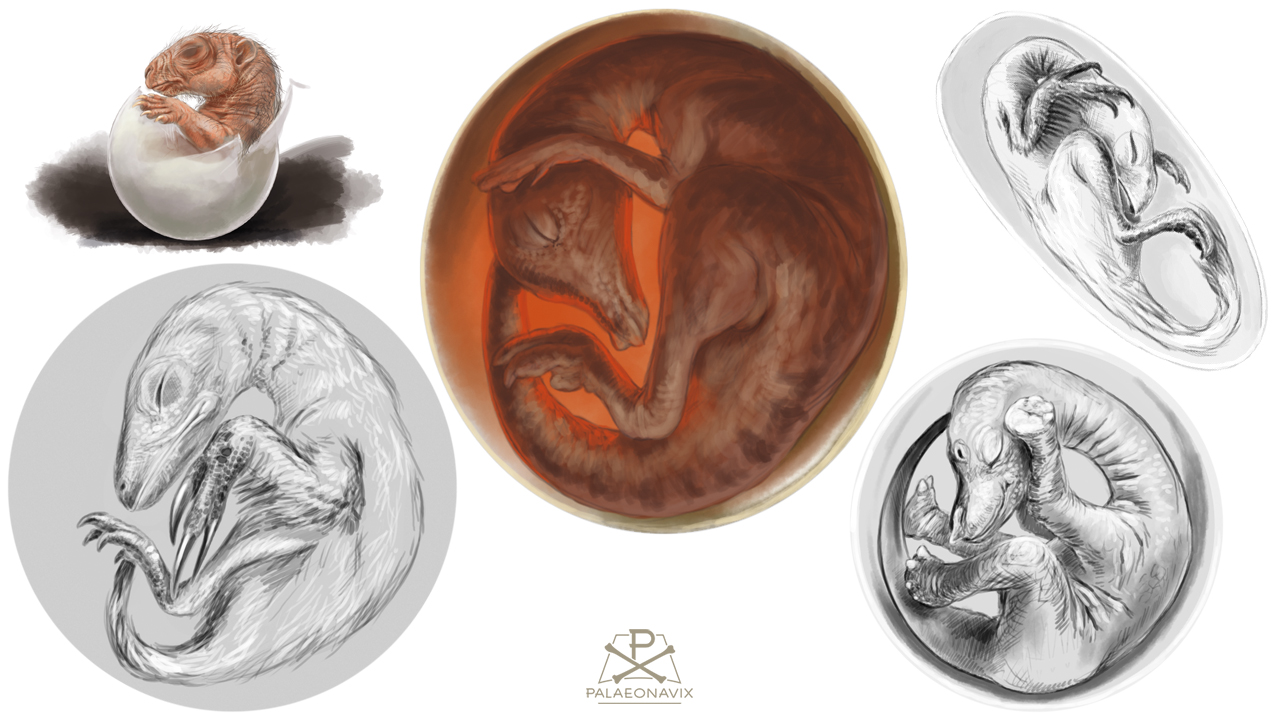
One synapsid, four dinosaurs. The latter provide the best data to reconstruct perinatal juveniles among all fossil groups. This is not only because of size, but also the widespread hard-shelled condition of eggs (which most likely evolved in multiple lineages). After all, such fossils repeatedly come from the same dinosaur subgroups, leaving out others. The explanation might include lagerstaetten effects to sampling bias, but probably also palaeobiological signals such as egg type or preferred nesting habitats. Here are the “common” ones, starting with the coloured one in the centre, a generalised hadrosaurid (duck-billed dinosaur). The grey-scale sketches are, clockwise: an oviraptorid (bird-like) in its typically elongated egg; a titanosaurid sauropod (long-necked dinosaurs) with proven “egg tooth”; a therizinosaurid (scythe-clawed dinosaur), a potential colony breeder.
On the upper left, this is a sketch based on tritylodontian fossils. No eggshells of any fossil synapsids are known with certainty, as these would most likely be no significantly mineralised. This study is part of a larger topic (evolution of parental care) and refers to the large litter around the origin of mammals.