

Calamite strobili
pencil rendering after virtual modelling, 2014; artwork by Freddi Spindler
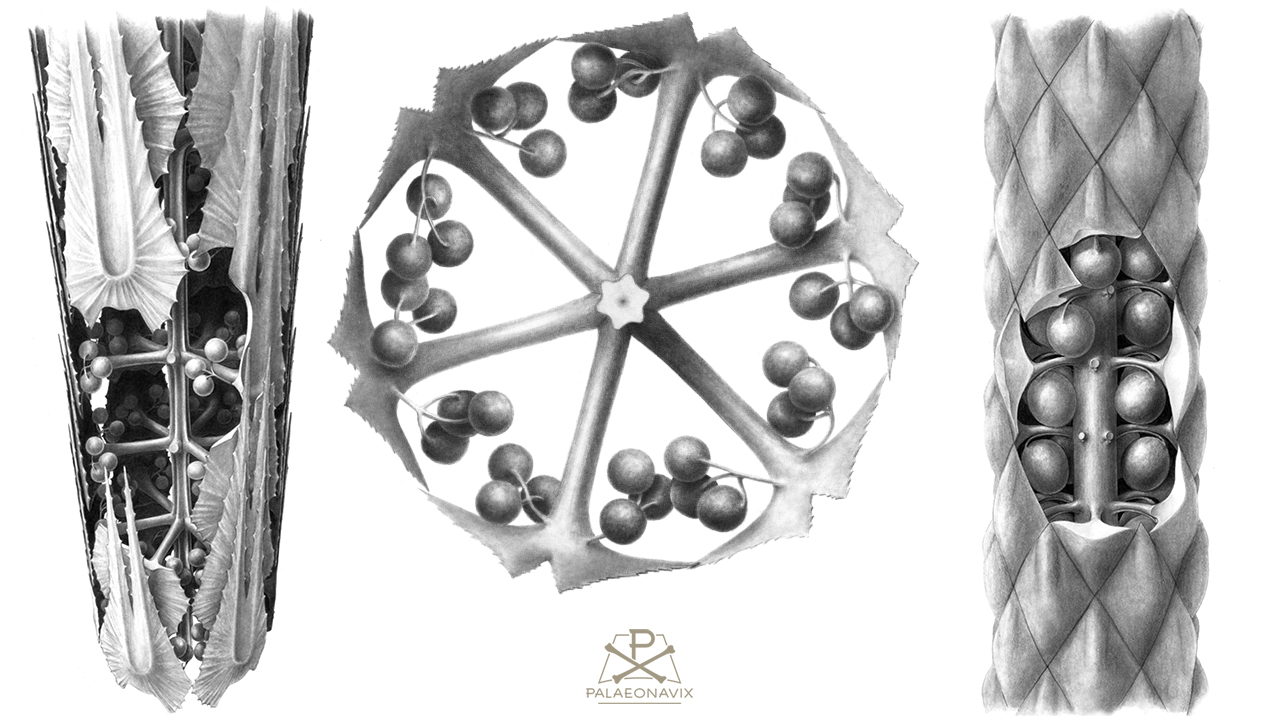
In the Saxon Döhlen basin, some layers provide cherts that include botanical details from the Early Permian. Due to three-dimensional preservation, insights from the true anatomy can be concluded that are impossible to observe in claystones or even limestone. Such data was gained using polished surfaces of different orientation. Lacking computed models, the reconstruction was sketched and provided as references for these pieces. They depict two types of calamite strobili, that is the sporangia structures of horsetail relatives: left Bowmanites (fertile organ of certain sphenophylles, genus Sphenophyllum), right Metacalamostachys (fertile organ of the giant horsetail Calamites gigas). The part in the centre is a sectional view of the left one. All have a width of a few millimetres in life, containing tiny spores attached to the shafts of the outer bractea (these shield-like scale-leaves) of each strobilus.