Thuringian Forest early amniotes
digital art, 2024
see also Permian megafauna
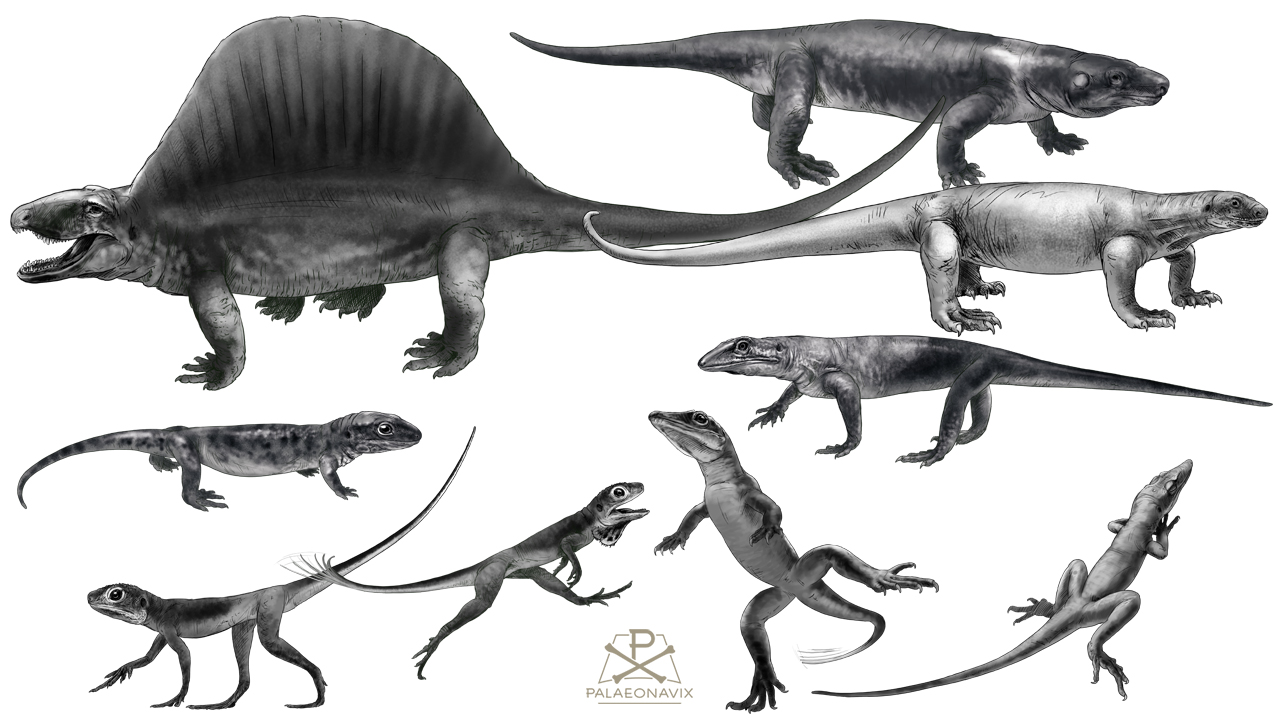
For a long time, Early Permian tetrapod assemblages were mainly known from North America, at least when it comes to amniotes. In Europe, where smaller basins are the dominant outcrop situation, a long research history exists for amphibians, but early synapsids (“pelycosaurs”) are scarce, and still more abundant than early sauropsids (stem reptiles). There are only three rich assemblages from the Early Permian of Europe, all from Germany. A review article about the Thuringian Forest Basin deals with the most popular of these: the Bromacker Site near Tambach-Dietharz. The sketches shown here are semi-scientific, based on not too intensive reconstructions. The big one with a back sail is Dimetrodon teutonis (the only species diagnosed outside North America), below the reptiles Thuringothyris and the supposed semi-bipedal Eudibamus. On the right, the uppermost is a diadectid, Orobates, followed below by the early caseid Martensius and the varanopid Tambacarnifex.
On the lower right, two studies show the lizard-like varanopid Cabarzia. This is from another locality, the Inselsberg quarry. Its proportions suggest that this is potentially the oldest known case of semi-bipedalism, used under the highest acceleration. As for Eudibamus, I felt it was needed to show also resting postures. Beyond the original description, the mentioned overview includes the first jaw fragment that matches the classification of Cabarzia as a close relative of Mesenosaurus.