

Palaeozoic colonial filterers using zoom
digital painting 2025
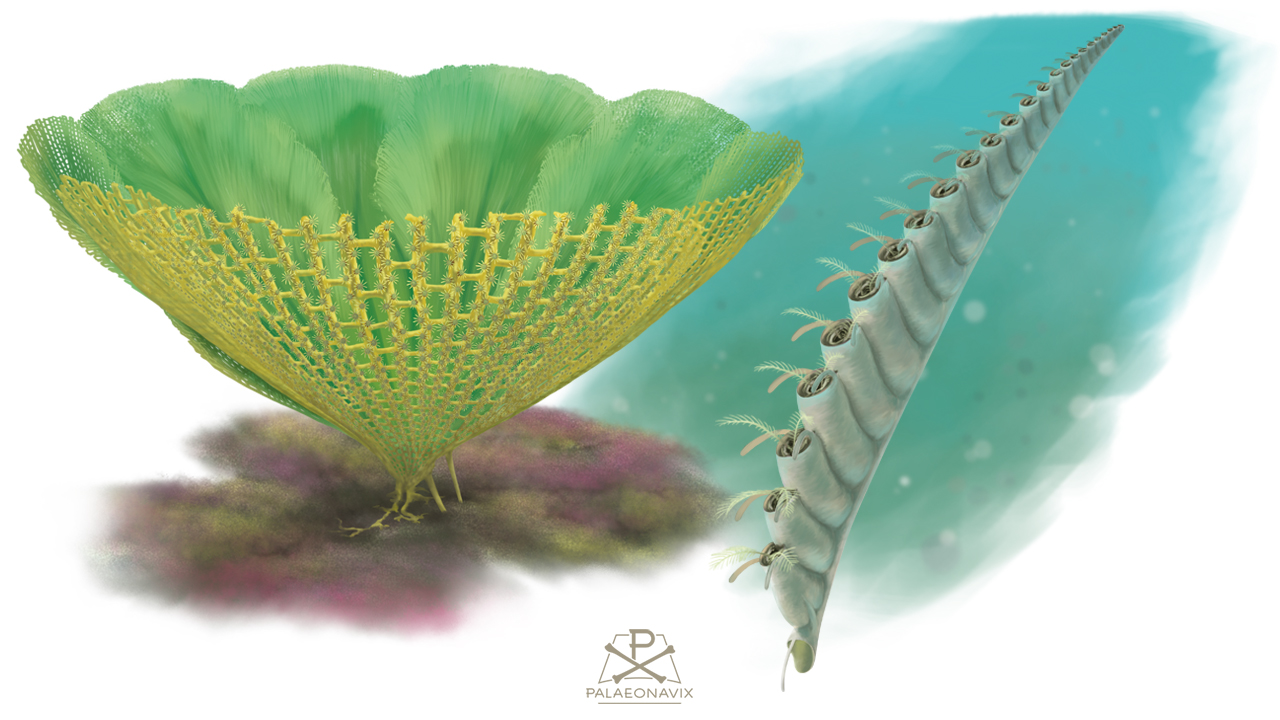
They may not be the stars of major shows and exhibitions, but they are ecologically very important and well known to some amateurs, at least enthusiast palaeontologists. Here are two representatives of marine filter feeders, a bryozoan and a graptolite.
Bryozoans are phylogenetically close to brachiopods, although they had already separated around the early Cambrian. They live sessile, i.e. fixed to the seabed. Very similar to various corals, many small zooids form a common skeleton, in the case of this Fenestella from the Palaeozoic, a funnel-shaped lattice structure consisting of several divided leaves. Other bryozoans form turrets, flat pads or even screws. In order to show both the individual chambers with actively filtering tentacle wreaths of the interconnected animals, and at the same time the overall shape of the colony, an exaggerated zoom of the front edge has been used. The result is definitely alienating due to the mismatched scales in the image depths. There would certainly have been alternative approaches. In the end, the message is clear and it is more of an informative educational illustration than a real-life appearance that would belong in an environmental scene.
Graptolites belong to the Deuterostomia, a broad clade that also includes vertebrates and echinoderms. Graptolites are somewhat closer to the latter and are classified as Pterobranchia, which still exist today and usually have worm-like bodies that live in self-separated tubes. The early Palaeozoic graptolites were able to form floating colonies of various shapes. Only a few centimetres long, they were part of the macroplankton. This Monograptus shown here was one of the most simply built. Known details of the growth pattern, in particular the “sicular zooid” as the initial stage for the colony, were just as interesting as the overall shape, which is recognised in the macroscopic fossil. This is why a particular zoom was chosen here as well.