

Carnivora, namely the Challenging Apex Predators
tempera, maybe 2012
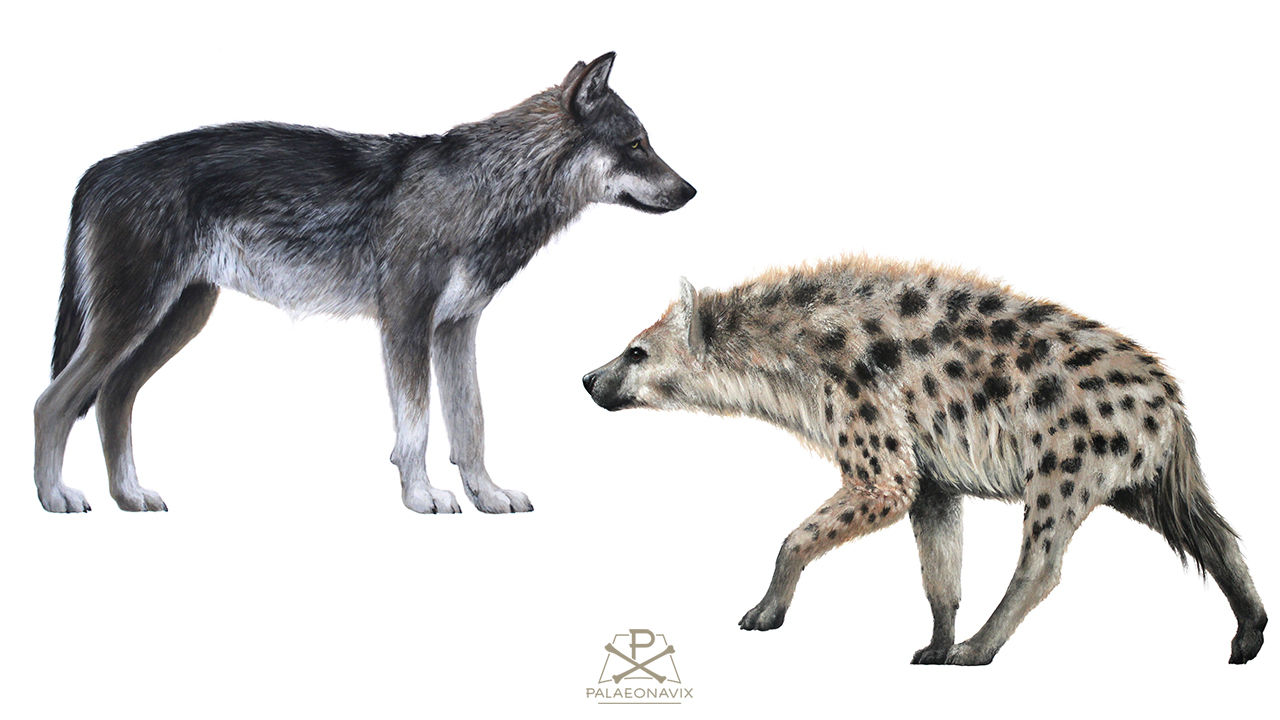
These two predators were painted for a cycle of ice-age mammals in order to demonstrate: Back then, roughly the same animals were around, but somehow bigger and stockier. Keyword being Bergmann's and Allen's effect. The best are these two pieces of wildlife illustration, and definitely not just reproductions of underlying reference photos. You are looking at a common wolf, Canis lupus, and a spotted hyena, Crocuta crocuta.
Both species are to some extent the challengers of their coexisting apex predators. It would be wrong not to treat the wolf as a top predator. In the natural environment of the Eurasian temperate zone, the lynx is too scattered, and big pantherine cats are not consistently represented. The much larger bears are not hypercarnivores, the cave bear is even an herbivore. Wolves, on the other hand, are probably the ideal and widespread apex predator. Nevertheless, they were sometimes only in a secondary position next to brown bears and pantherine cats, in the glacial period even to the sabre-toothed cat Homotherium. The fact that a bear and a wolf were observed some time ago, apparently in close cooperation, is certainly an exception, but certainly proof of their intelligence and adaptability.
Ever since “The Lion King”, the world has been familiar with the war between hyenas and lions. Less well known is their large ecological overlap. Hyenas are not just freeloaders who take the lions' fresh carrion (the males do exactly the same, only somehow legally). Hyenas can hunt actively. Sometimes even lions. Conversely, lions also eat fresh carrion, even if they are much less tolerant of it (almost impossible with the closely related leopard). In addition, hyenas and lions fight each other by killing the offspring of their enemies when given the opportunity. All this shows that they are competing for the same place in the ecosystem, at least to a large extent.
It remains uncertain to what extent this relationship can be transferred to ecosystems other than the African savannahs of the Holocene. As top predators, they have always been particularly vulnerable to disturbance and were unfortunately decimated or even extinguished very early on in North Africa, parts of Europe, the Arabian Peninsula and as far away as India. Not everywhere the same species encountered each other. One must also ask when and where the lions developed the highly social pack life in open landscapes – an almost unique behavior within the entire known family of cats = Felidae (there is some indication of social groups in the sabre-toothed cat Smilodon, and initially in cheetahs). Even dogs other than wolves and African wild dogs are hardly social beyond caring for their young. Similarly, the spotted hyena is an exception among the otherwise solitary hyenas, and the pack life of the cave hyena in Ice Age Europe is by no means proven (the Siegsdorf lion might have fallen victim to a hyena clan).
A few tens of thousands of years ago, wolves and hyenas met in Central Europe. Cave finds with bitten bones show that the hyena had a taste of the wolf. It is quite possible that the challenges posed by some predators went in every conceivable direction. Today, in the Holocene, wolves and hyenas are neatly separated. Perhaps better for both.