

Fayolia as xenacanthiform egg capsules
digital painting 2025, predrawings from 2010
Fossil of the Year 2025 / sketches
meet the xenacanthiforms Orthacanthus and Bohemiacanthus
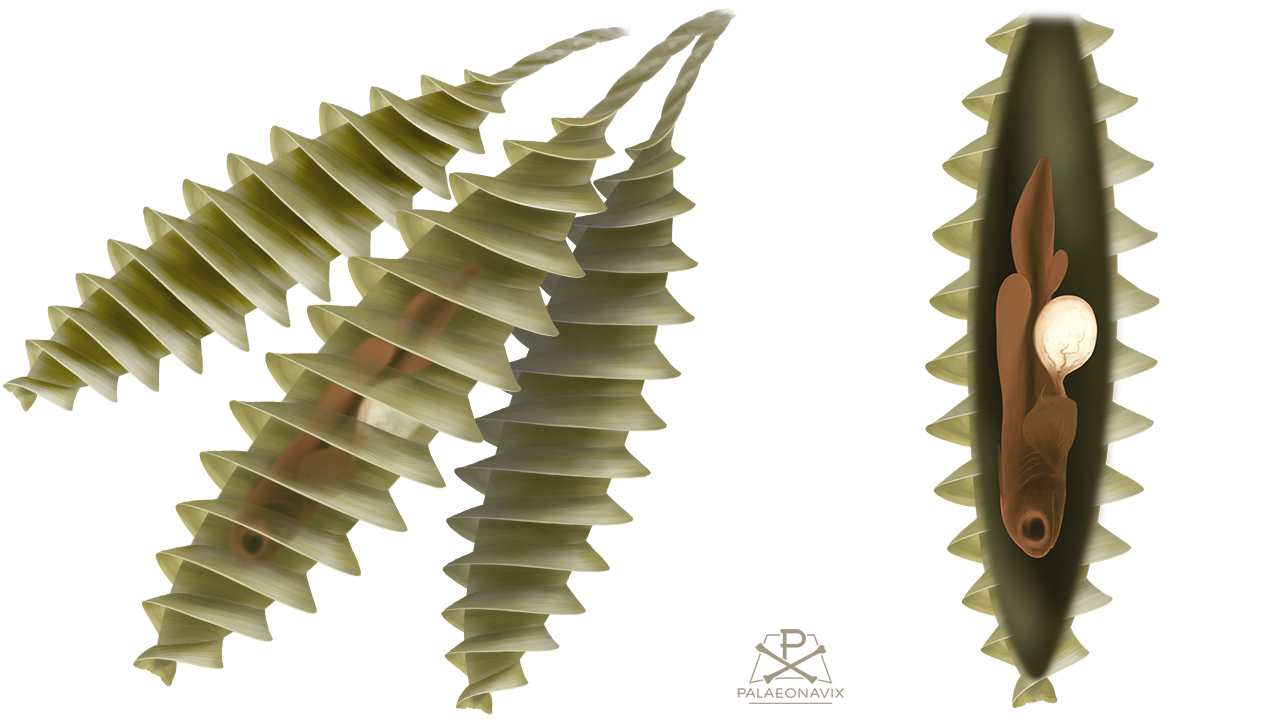
Fayolia is not really an animal, but its egg. Like traces that form their own naming system, those genera and species describe more the fossil object, such as the characteristics of a footprint or burrow, or coprolite. Therefore, a so-called ichno-taxon can correlate with several true species, their trace-makers, and vice versa, a certain trackmaker could produce a spectrum of traces, depending on its behaviour or substrate. A similar concept exists for eggs, although it is a bit odd that they are treated as trace-fossils in many classifications. Unlike nests or stomach content, which is foreign matter shaped by a living being, eggshells are a direct product of the body, in many cases even built off biominerals. They are enveloping the embryo, so eggs bridge the condition of a maternal to an offspring body, like an umbilical cord does. The mere fact that it is related to behaviour would require to treat even lost teeth as traces. Well, the limits of an artificial system…
The correlation of Fayolia bases on extant sharks with similar egg types, palaeo-environment and stratigraphic range. It is broadly accepted that it belonged to certain xenacanthiform “sharks”, in fact stem-group sharks from an older stage than the split of true sharks and rays. No embryo has ever been found in any of the capsules, but their occurrence in bundles is a known condition.