

Pliosaurus kids
digital model, used for life-size 3D print (3 m long, on pedestal)
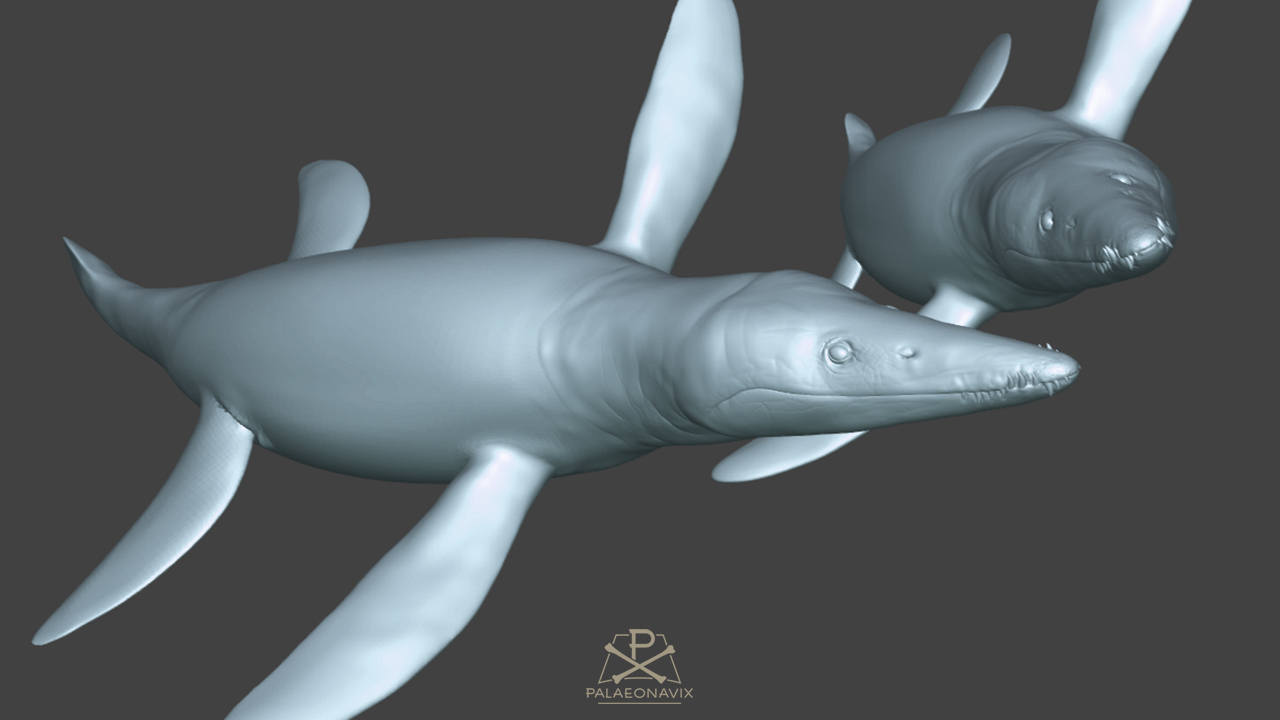
In the Late Jurassic “Solnhofen archipelago” (plattenkalk localities of the southern Franconian Alb), marine life is recorded in great diversity. Among the many marine species, reptiles should be rare due to their higher position in the food chain. Still, the rareness of sauropterygians (plesiosaurs, pliosaurs) is remarkable. There was one large historical tooth find, considered as lost, and we were lucky to discuss a few teeth with dissolved root, thus originating from living individuals. No trace of any long-necked plesiosaur, and nothing left of a personal note I heard about a collector possessing some vertebrae or so. The teeth should all be Pliosaurus.
In the meantime, I’ve been shown an isolated larger bone, probably also Pliosaurus. And then there was this collector presenting two fragments of what once was a humerus or femur. Our discussion led to a baby Pliosaurus as the most likely classification but is currently checked again. Anyway, we took this opportunity to build a model of appropriate size, after the regional Nature Park asked for a selfie point. Big saurian and based on actual findings – seemed to be the best solution, and more representative than any tiny, terrestrial Solnhofen theropod.
Based on the tooth finds, we estimated the grown pliosaurs to about 8 m as a plausible, though barely precise measurement. Given that a Cretaceous sauropterygian was found pregnant with a single and super-large baby, it is possible that baby Pliosaurus could not be much smaller than 2 or 3 metres. Even as neonates they were stronger and more terrifying than any living crocodile!