

Solnhofen flying theropods
digital painting 2025
see Solnhofen flightless theropods / bird-line evolution / Archaeopteryx' environment
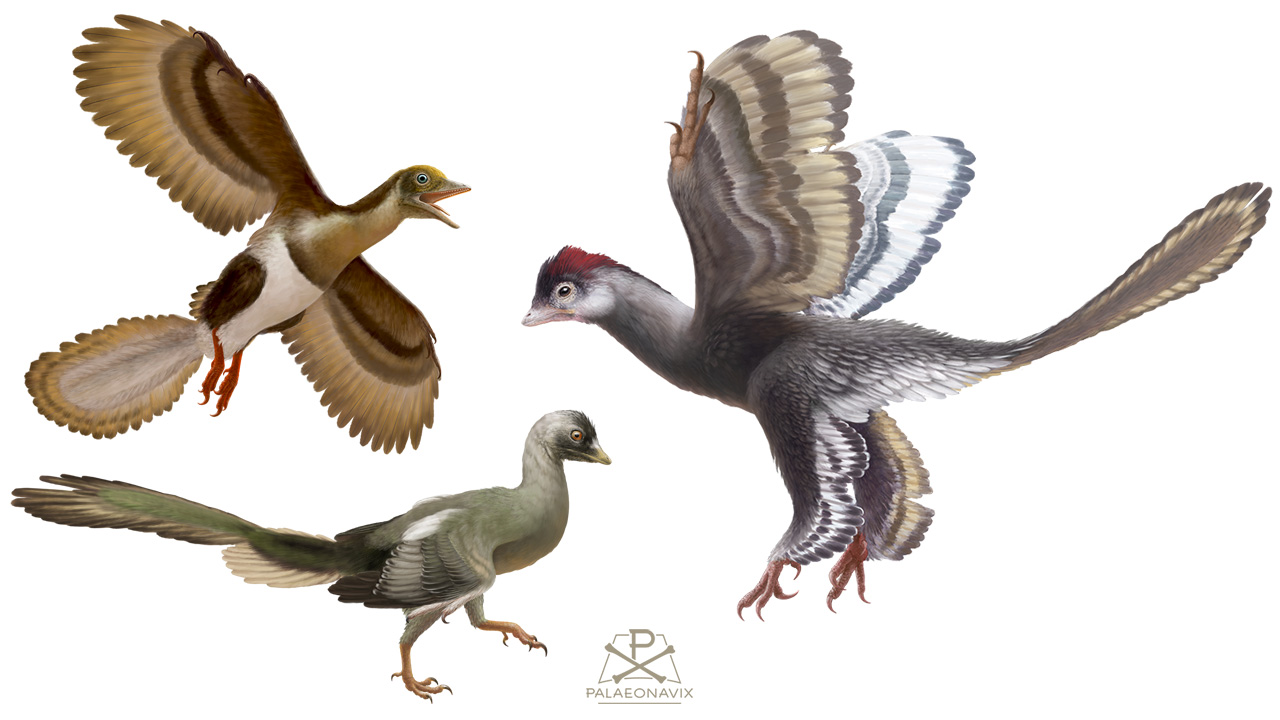
The famous primeval bird or "Urvogel" Archaeopteryx, perhaps the most important and certainly one of the best-known fossils of all, comes from the island world of the late Jurassic, today in the heart of Bavaria. It is no longer just Archaeopteryx alone, nor is it just one species of this genus. Despite their scarcity, there are some organisms from the Solnhofen limestones that are much rarer. Archaeopteryx has also lost its sole status as a primeval bird and thus the key witness of evolution, so that the early phase of the bird's lineage is now known in considerable detail. Recent research has even shown that feathered predatory dinosaurs developed the ability to fly three, four or even five times. However, according to all analyses, Archaeopteryx stands at the root of the only lineage that has survived to this day in the form of modern birds, saving this genus as the true "Urvogel" and some kind of an icon of palaeontology.
Archaeopteryx is shown flying on the left of the slide. This prehistoric bird was certainly not an elegant ocean flyer but probably drifted by storms from the mainland to the archipelago. However, it had generally good flight characteristics. This is demonstrated by the pronounced asymmetrical wing feathers, the long feathers on the upper arm (according to the latest study, they could even be reconstructed a little longer), the large muscle insertion on the upper arm and the reconstructed anatomy of the shoulder. The control of the tendons during wing movement was still very different from that of modern birds, so that the small sternum of the primeval birds is no longer an argument for poor flight characteristics. Admittedly, Archaeopteryx was not like a falcon, but neither was it a clumsy domestic chicken.
Alcmonavis is depicted walking on the ground below. The image can hardly be considered a reconstruction, at best a symbolic image. Because not much more than a wing skeleton is known. The first analysis revealed a phylogenetic position just above the side branch of Archaeopteryx, i.e. closer to the modern bird and with improved flight characteristics. Subsequent analyses differed in terms of the relationship, but the genus Alcmonavis undoubtedly plots around the origin of the birds. As a fiction and partially based on the last long-tailed ancestral birds of the Cretaceous period, the hind limb plumage is reduced, and the large set of rectrices is divided into two compartments along the caudal spine.
On the right we see Ostromia fluttering. The re-evaluation of a historical Urvogel find revealed that it belonged to an independent family, the anchiornithids. These animals are usually regarded as a slightly more basal lineage than the archaeopterygids. Apparently, not all of them can universally be regarded as fliers, which is why the very incompletely known Ostromia is merely an assumption. The remiges-like feathers form clear wing-shaped fans down to the metatarsus. The colouring is taken from the eponymous genus of the family Anchiornithidae: A black and white pattern along with a reddish head crest have been proven!