Trilobites: motile fortresses
digital painting 2024
see further arthropods like aquasaurs
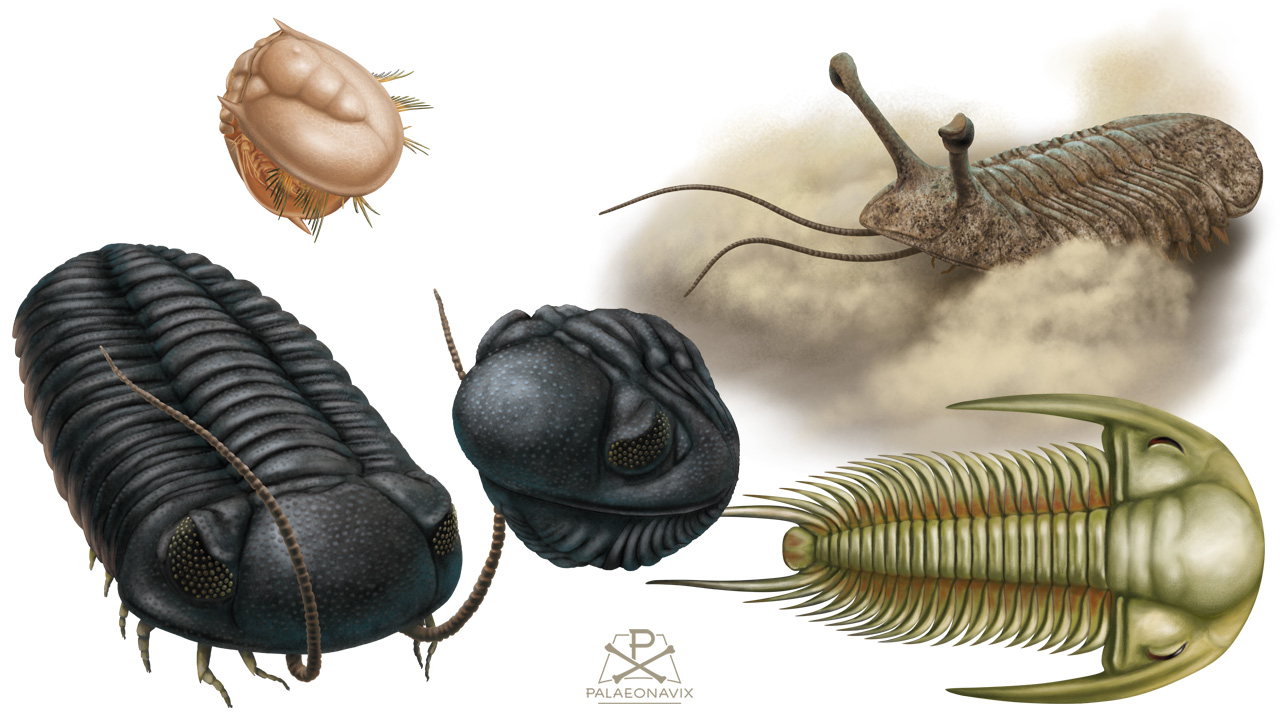
Trilobita are found in the Palaeozoic. Their arthropod nature was always obvious, given their exoskeleton, appendages and eye structure. But without living representatives, though with a confusing mass of potential ancestors, it was a long debate finding their relationship among Arthropoda. To present the rough outlines: Trilobites belong to the Antennulata, for having antennae and thus being apart from the group comprising spiders, scorpions or horseshoe crabs, but fall outside the Mandibulata, the group of e.g. millipedes and all kids of crustaceans including insects.
On the upper left is the tiny Agnostus, a very early form with only few middle pleurae, leaving the cephalon and equal-sized pygidium to form corresponding lids. The below Phacops, a predator with huge eyes, shows a similar ability to close the dorsal armour by rolling the thorax. Asaphus on the upper right exhibits a pygidium larger than the cephalon (the stalk eyes are a specific of few forms). Paradoxides, lower right, has a reduced pygidium in favour of spiny tips of all pleurae and the cephalon.