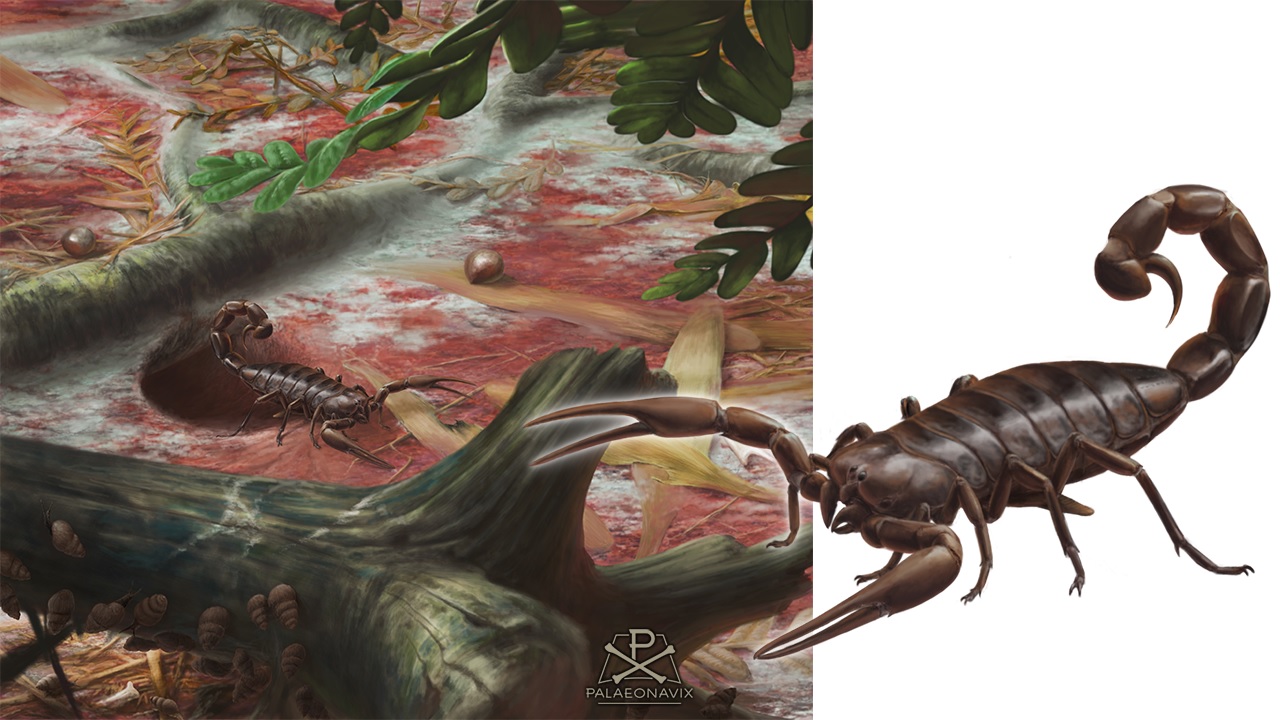
The classic locality of the Petrified Forest in Chemnitz, Germany, is not only a palaeo-botanical site. It became even more famous after a series of animals was found, including a tree-climbing amniote, a terrestrial temnospondyl, or aistopods. One of the most spectacular finds was a holomorphic scorpion, Opsieobuthus tungeri, also known from a burrow and exuvial remains. Although representing an extinct family, this is a crown group scorpion with very modern looking affinities. During the volcanic eruption that buried the Chemnitz forest one unlucky Early Permian day, the soil fauna had no real chance to escape. That’s why bigger tetrapods and insects are missing in the so far recorded assemblage. All elements in the image, however, are based on true fossil evidence from only a few square metres: fronds and fruits, snails underneath deadwood, tiny bones in the litter, and a scorpion’s lair using a living root for stabilisation.
Folgen:

Fossil scorpion
palaeo illustration






Atelier für Paläo-Illustration, wissenschaftliche Rekonstruktion und Fossilpräparation.
Dr. Frederik Spindler.
Atelier
Rechtliches
Folgen
© 2026 Palaeonavix

