

Dakosaurus vs. Shark
digital painting, 2026
see scientific drawing and sculpted marine croc
Dakosaurus' position in the ecosystem
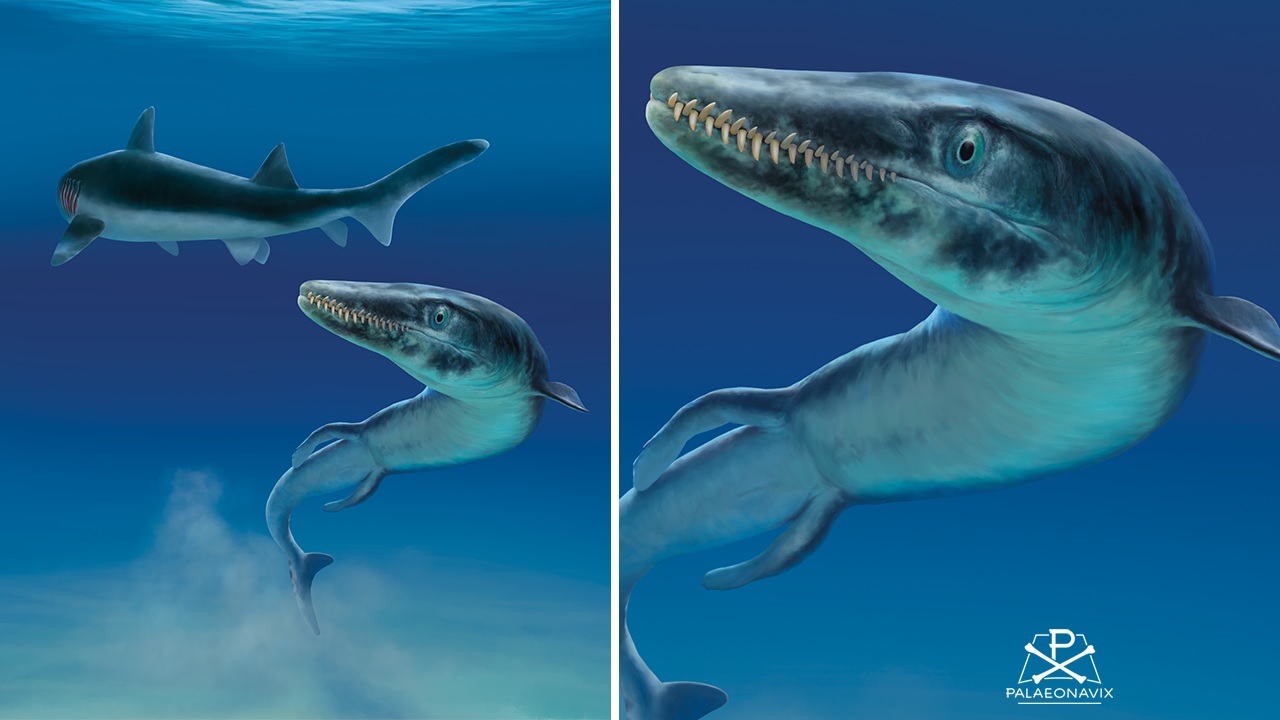
In the Late Jurassic Solnhofen Archipelago, the top predator was the large but rare Pliosaurus. Most of the time, the shallow waters were plagued by two stem group representatives of potentially higher predators in today’s food webs. The first any obviously the focussed player in this scene is Dakosaurus, of which a 5 m long skeleton gave the first opportunity to reconstruct the entire body beyond guessing (isolated teeth imply even bigger individuals). These fully marine crocodylomorphs had ichthyosaur-like bony eye rings, a feature that is absent in any form amongst most croc-like archosaurs. From that is known about articulated dentitions, it is likely that there was no lip covering, which contributes to the differences from their ecological heirs, the Cretaceous mosasaurs.
The second predator would be hybodont sharks, in this case Asteracanthus, which is a 3 m long relative of modern sharks and among the biggest cartilaginous fish in this Jurassic setting. There is some indication that modern sharks should be around – including the lamniforms, ancestral to the Great White. Still, the dominant fossil record tells us that true sharks were right before their big moment. Who knows what they had prepared in the endless ocean, a region that is barely preserved in the known fossils. Here, in what is today Southern Germany, hybodont sharks were at risk of becoming a meal for Dakosaurus – proven by stomach content!